Anti-Inflammatory Supplements for Joint Pain: What the Evidence Actually Says
If you've tried turmeric supplements and felt underwhelmed, you're not alone — and you're not imagining it.
Ingredients in this letter

TL;DR
- Most single-ingredient supplements (like plain turmeric capsules) show modest results because joint discomfort involves multiple overlapping inflammatory pathways - not just one.
- The ingredients with the strongest evidence for joint support include Boswellia serrata, curcumin with piperine, and resveratrol - each working through distinct mechanisms.
- Bioavailability matters enormously: curcumin alone absorbs poorly; paired with piperine it absorbs up to 20x better.
- A clinical study using a standardized multi-pathway formula showed a 22-point reduction on the McGill Pain Questionnaire at 8 weeks (p=0.042).
- Bottom line: If your current supplement isn't working, the most likely reason is that it's only addressing part of the problem.
Why Single-Ingredient Supplements Often Fall Short
If you've tried turmeric supplements and felt underwhelmed, you're not alone - and you're not imagining it.
Joint discomfort doesn't operate through a single mechanism. Inflammation at the joint level involves at least six distinct biochemical pathways: COX-2 enzyme activity, 5-LOX activity, cytokine signaling, oxidative stress, neurological sensitization, and supporting pathways involving neurotransmitter balance. When you take a product that targets only one of them, you're addressing one thread in a web that has six.
This is the central problem with most anti-inflammatory supplements on the market. They're built around a single hero ingredient, often at a dosage or form that doesn't absorb well, and they only address part of what's driving your discomfort.
The research increasingly supports a different approach: multi-pathway formulas with standardized, bioavailable ingredients that work together. This post walks through what the evidence actually says - ingredient by ingredient - and explains why the combination matters as much as the components.
The Ingredients With the Strongest Clinical Evidence
Boswellia Serrata (Targets the 5-LOX Pathway)
Boswellia serrata, derived from the resin of the Boswellia tree, is one of the most studied botanical ingredients for joint support. Its primary active compounds - boswellic acids, particularly AKBA (acetyl-11-keto-beta-boswellic acid) - are selective inhibitors of the 5-lipoxygenase (5-LOX) enzyme.
5-LOX is responsible for producing leukotrienes, a family of inflammatory mediators that play a significant role in joint tissue inflammation. Most common NSAIDs target COX enzymes but leave 5-LOX untouched. Boswellia covers the ground they don't.
A 2003 randomized controlled trial published in Phytomedicine found that participants taking Boswellia serrata extract reported significant improvements in knee discomfort scores, walking distance, and frequency of swelling compared to placebo - with effects appearing within 8 weeks. A 2008 study using a proprietary high-absorption Boswellia extract (5-Loxin) showed meaningful changes in pain and physical function scores after just 7 days.
For quality, look for products that standardize the extract to a specific percentage of boswellic acids. Unstandardized "Boswellia powder" products vary widely in potency.
Curcumin + Piperine (Targets COX-2 and NF-κB)
Curcumin is the active polyphenol in turmeric root, and it is legitimately impressive in the research - but with a critical caveat. Raw curcumin has notoriously poor bioavailability. Studies show that curcumin consumed alone is rapidly metabolized and eliminated before it can accumulate at meaningful concentrations in the bloodstream.
Piperine, the active alkaloid in black pepper, changes that equation. Research published in Planta Medica demonstrated that 20mg of piperine consumed alongside 2,000mg of curcumin increased curcumin bioavailability by 2,000% (20-fold) in human subjects. This is why the pairing of curcumin with piperine isn't just a marketing claim - it's a pharmacokinetic necessity.
Mechanistically, curcumin inhibits COX-2 enzyme activity (one of the primary drivers of joint inflammation) and suppresses NF-κB, a transcription factor that acts as a master switch for multiple inflammatory genes. A 2016 systematic review analyzing randomized controlled trials concluded that curcumin supplementation was associated with reduced inflammatory markers including CRP and IL-6.
Resveratrol (Antioxidant and Cytokine Modulation)
Resveratrol is a polyphenol found in grapes, red wine, and Japanese knotweed. It's gained attention not just as an antioxidant, but as a SIRT1 activator - a pathway associated with reduced inflammatory gene expression.
In the context of joint support, resveratrol's primary value is in attenuating oxidative stress in joint tissue and modulating pro-inflammatory cytokines including TNF-alpha and IL-1beta. Animal studies have shown resveratrol to be protective against cartilage degradation, though human trial data is still developing.
What makes resveratrol a valuable inclusion in a multi-pathway formula is precisely that its mechanism differs from both Boswellia and curcumin. It's not redundant - it's complementary.
L-Serine and Choline (Membrane Integrity and Neural Signaling)
This is where multi-pathway thinking gets interesting, and where most consumer-facing supplement discussions fall short.
L-serine is an amino acid that plays a structural role in cell membrane phospholipids, particularly phosphatidylserine. Healthy cell membranes matter for joint support because inflammatory mediators are synthesized from arachidonic acid in membrane phospholipids. Supporting membrane integrity can influence the downstream production of inflammatory compounds.
Choline is a precursor to acetylcholine and phosphatidylcholine. It supports the anti-inflammatory cholinergic pathway - a neurological feedback loop that helps modulate systemic inflammatory response. A growing body of research suggests that the nervous system plays a more active role in regulating inflammation than was previously understood.
5-HTP, B6, and GABA (Neurological Sensitization Support)
Chronic joint discomfort doesn't stay purely in the joints. Over time, persistent discomfort signals can sensitize the central nervous system - a process called central sensitization - making the pain experience amplified beyond what the peripheral inflammation alone would produce.
5-HTP (5-hydroxytryptophan) is a direct precursor to serotonin, a neurotransmitter involved in pain modulation. Vitamin B6 is a required cofactor for this conversion. GABA (gamma-aminobutyric acid) is the primary inhibitory neurotransmitter in the central nervous system and plays a role in dampening sensitized pain signaling.
These aren't pain medications. They support the neurological environment involved in how the body processes and modulates discomfort signals. In a formula designed to address joint discomfort comprehensively, ignoring the neurological dimension leaves a meaningful pathway unaddressed.
Why the Multi-Pathway Approach Outperforms Single Ingredients
Here's a way to think about it: joint discomfort is like a fire with multiple oxygen sources. You can put out one source of oxygen, and the fire keeps burning. To actually resolve the problem, you need to address multiple inputs simultaneously.
This is why formulas engineered around pathway coverage - rather than around a single impressive ingredient - tend to produce better clinical outcomes.
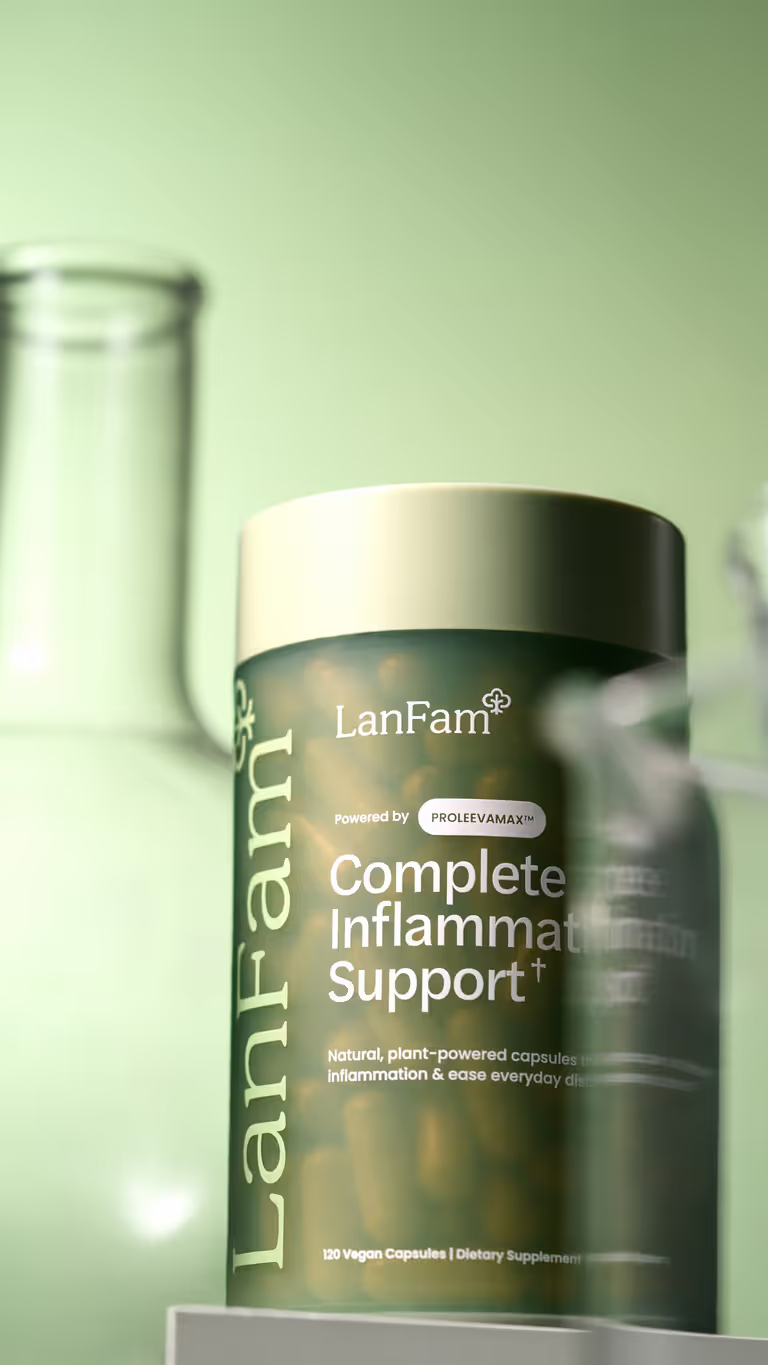
The formula behind LanFam Health's Complete Inflammation Support, powered by ProleevaMax, was designed around exactly this principle. It combines 13 standardized botanical and amino acid ingredients targeting 6 distinct inflammatory pathways: COX-2 (curcumin + piperine), 5-LOX (Boswellia), oxidative stress (resveratrol), membrane and cytokine pathways (L-serine, choline), and neurological sensitization (5-HTP, B6, GABA).
A clinical study using this formula showed a statistically significant 22-point reduction on the McGill Pain Questionnaire at 8 weeks (p=0.042). The McGill is a validated, multi-dimensional pain assessment tool - not a simple 1-10 scale. A 22-point reduction represents meaningful real-world change in how participants experienced and described discomfort.
You can review the full ingredient rationale and sourcing detail on the LanFam Health ingredients page and the clinical evidence on the science page.
What to Look for When Choosing a Joint Supplement
Not all products are equal, even among those using the same ingredient names. Here's what to check:
Standardization. "Turmeric root" and "Curcumin 95% standardized extract" are not the same thing. Look for standardization percentages on the label - they indicate that the active compound content has been verified.
Bioavailability partners. Curcumin without piperine. Boswellia without specification of boswellic acid content. These are warning signs. Active compounds need to actually reach your bloodstream.
Pathway breadth. A formula built around a single ingredient or two is likely covering one or two pathways. Ask whether the formula addresses COX-2, 5-LOX, oxidative stress, and neurological sensitization - or whether it's leaving major pathways open.
Clinical evidence. Ingredient-level research is useful context, but formula-level clinical data - a study of the actual product, not just its components - is meaningfully stronger evidence.
Transparent sourcing. What is the Boswellia standardized to? Where is the curcumin sourced from? Companies that publish this information are generally more trustworthy than those relying on proprietary blends without disclosure.
How Long Do Anti-Inflammatory Supplements Take to Work?
This is one of the most common and most underanswered questions in this category.
The honest answer: it depends on the ingredient, the dose, and the individual - but most botanicals require consistent daily use over at least 4 to 8 weeks before their effects are fully measurable. Boswellia research shows meaningful effects at 7-8 weeks. Curcumin studies typically report outcomes at 8-12 weeks of continuous use.
This is not a supplement category where you take two capsules and feel a difference in 45 minutes. These are compounds that work gradually, through accumulation and sustained pathway modulation, not through acute pharmacological action.
The clinical study behind the ProleevaMax formula used an 8-week measurement window. That's the appropriate expectation frame - not days, but weeks of consistent use.
Getting a Formula That Actually Addresses the Full Picture
If your current supplement isn't doing what you hoped, the most likely explanation isn't that anti-inflammatory supplements don't work. It's that the formula you're using is incomplete - covering one or two pathways and leaving the rest open.
LanFam Health was founded by Fabio Lanzieri, with 40 years in pharmaceutical science, and Maria Lanzieri, a breast cancer survivor whose experience with chronic discomfort shaped the company's commitment to evidence over marketing. Complete Inflammation Support was formulated to cover what other products leave out - 13 standardized ingredients, 6 pathways, clinical data at 8 weeks.
It's available for approximately $40/month on subscription, and it comes with a 90-day money-back guarantee - because the clinical evidence required 8 weeks to show results, and we think you deserve enough time to actually evaluate whether it's working.
If you want to go deeper on the science behind the specific ingredients and their dosing rationale, the ingredients page and science page are a good place to start. And for context on how multi-pathway approaches compare to traditional options, see our related post on why most joint supplements don't work.
FDA Disclaimer
These statements have not been evaluated by the Food and Drug Administration. This product is not intended to diagnose, treat, cure, or prevent any disease. The information in this article is for educational purposes only and is not a substitute for professional medical advice, diagnosis, or treatment. Always seek the guidance of your physician or another qualified health provider with any questions you may have regarding a medical condition.

Frequently asked questions
There's a seat at our table
Letters from our family to yours — the science, the recipes, the things that actually helped real families. Leave your email and we'll send the next one.