Does Boswellia Increase Estrogen? What the Research Actually Says
Does boswellia increase estrogen? No — boswellia isn't a phytoestrogen. Here's what the research actually shows about boswellia and your hormones.
Ingredients in this letter
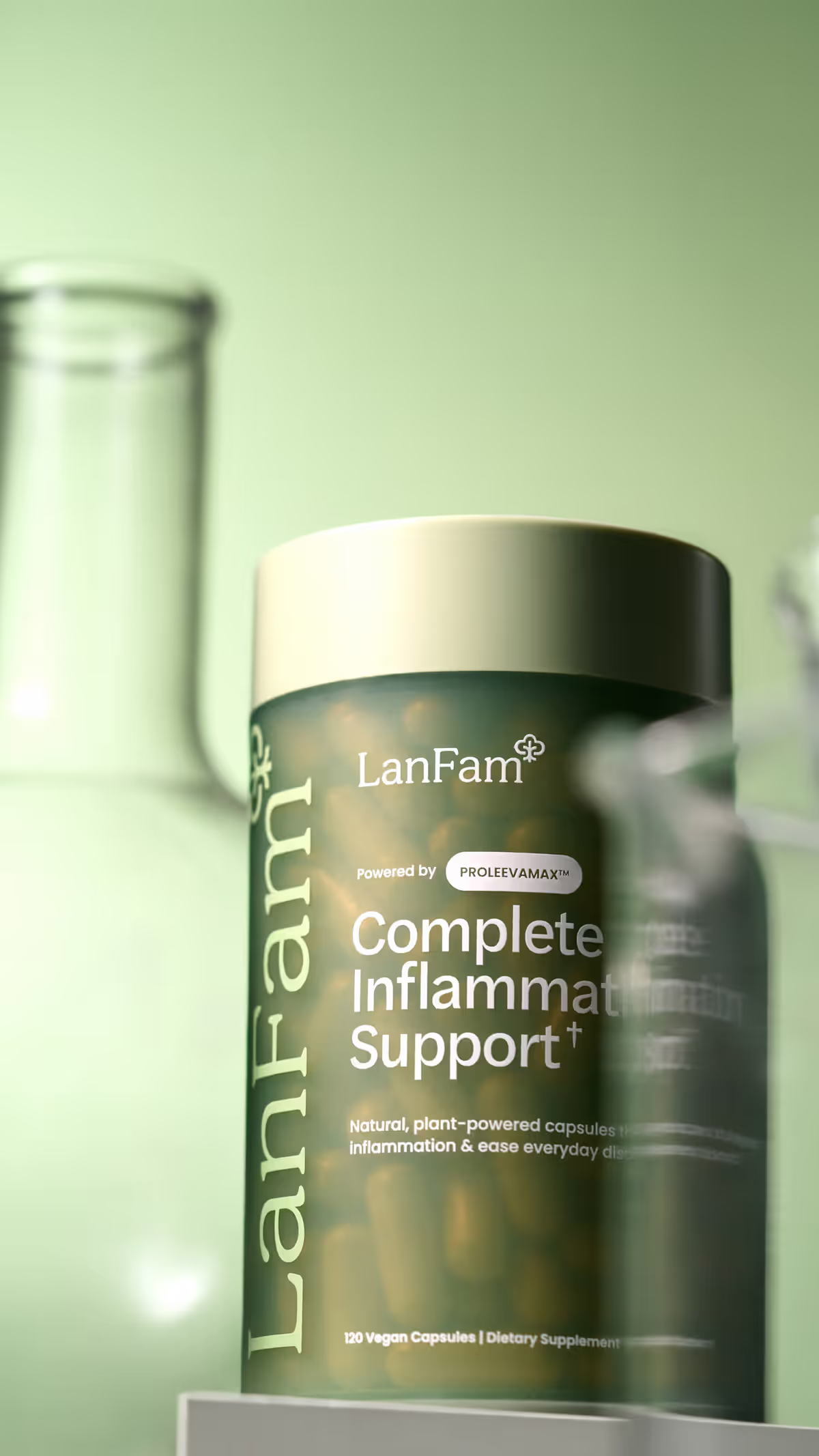
The direct answer: boswellia does not raise estrogen, and it is not a phytoestrogen
There's no evidence that boswellia increases estrogen. And the more important distinction underneath that — the one that actually settles the worry — is this: boswellia is not a phytoestrogen.
That word matters. A phytoestrogen is a plant compound shaped enough like estrogen that it can slot into your body's estrogen receptors and mimic (or sometimes block) the hormone's signal. Soy isoflavones do this. Red clover does this. It's a real category with a real mechanism.
Boswellia is not in that category. Its active compounds — the boswellic acids — aren't built to fit an estrogen receptor, and the research on how boswellia works has never described it acting on the hormone system at all. When scientists study boswellia, they study a different machine entirely.
So when you ask "does boswellia affect hormones," the honest answer is: not through any mechanism anyone has documented. It's working somewhere else in the body completely.
What boswellia actually does — the 5-LOX story
Here's the part that explains everything.
Inside boswellia is a family of compounds called boswellic acids, and the one that does most of the heavy lifting is a mouthful called AKBA (acetyl-11-keto-β-boswellic acid). AKBA's job is to sit on an enzyme called 5-lipoxygenase — 5-LOX for short.
Think of 5-LOX as one of the assembly lines your body uses to manufacture inflammatory signals. It takes raw material and turns it into leukotrienes — messengers that ramp up an inflammatory response. When that line runs hot for too long, you feel it: stiff joints, achy mornings, the sense that your body is louder than it should be.
What boswellic acids do is slow that one assembly line down. They dampen 5-LOX, fewer leukotrienes get made, and the inflammatory signal settles. That's the whole mechanism — an enzyme being quieted, the way decades of research has described it (Ammon 2010; Siddiqui 2011; Ammon 2006).
Notice what's not in that sentence. No receptor mimicry. No hormone. No estrogen. The mechanism lives entirely in the inflammatory-enzyme world. Boswellia and your hormones are simply running on different tracks.
This is also why boswellia has been studied for joint comfort rather than hormone balance. A 2020 meta-analysis pooling the human trials found boswellia supported measurable improvement in osteoarthritis symptoms (Yu 2020), and a more recent randomized controlled trial reported the same direction of effect for knee discomfort (Perez-Pinero 2023). Researchers point boswellia at aching joints because that's where the 5-LOX mechanism actually does something — not at the endocrine system.
Boswellia is one of the 13 standardized actives in ProleevaMax, and it's in there for exactly this reason — to help support a healthy inflammatory response* — not for anything hormonal.
Why this question comes up at all (and why it's a smart question)
If boswellia has nothing to do with estrogen, why does "does boswellia increase estrogen" get typed into search bars so often?
Two reasons, and both are completely reasonable.
The first is menopause. A lot of the people who reach for a joint supplement are women in perimenopause or menopause — and that's the exact window where the aches show up. Here's the part nobody connects for them: during the menopause transition, estrogen is falling, and as it falls, inflammatory markers tend to rise. Estrogen normally plays an immune-calming, anti-inflammatory role in the body (Taneja 2018; Straub 2007). Take that calming influence away and the inflammatory side of the ledger gets louder — which is part of why joints that were fine for forty years suddenly aren't (Tschon 2021).
So a woman in menopause is looking for relief in the same season her hormones are in flux. It's natural to vet every bottle for hormonal effects — is this going to mess with hormones that are already all over the place? Smart instinct. With boswellia, the answer is no: it isn't adding estrogen, it isn't a phytoestrogen, it's just working on that inflammatory enzyme.
The second reason is that people with hormone-sensitive conditions are taught to be vigilant. If you've had an estrogen-receptor-positive breast cancer, or you live with endometriosis, you've been told — correctly — to steer clear of anything estrogenic. That training is good. It's exactly why Carol asked before she took anything. And the reassurance I can give honestly is that boswellia is not in the phytoestrogen category that warning is aimed at.
"Is boswellia safe during menopause?" — the honest version
For most women navigating menopause, boswellia's mechanism is unrelated to the hormonal shifts going on — it's working on inflammation, not estrogen. That's the reassuring part, and it's true.
But "safe during menopause" deserves the full, honest answer, not just the comforting half.
Two cautions belong on the table:
- Hormone-sensitive cancers and hormone therapy. If you have, or have had, a hormone-sensitive cancer, or you take hormone therapy or an estrogen-blocker like tamoxifen, the issue isn't that boswellia is estrogenic — it isn't. The issue is drug metabolism. Boswellic acids can influence the liver's CYP enzymes, the same system your body uses to process many prescription medications. That means the prudent move is provider sign-off — let your oncologist or doctor confirm it won't interfere with a medication you depend on. This is a "clear it first" situation, not a "boswellia raises estrogen" situation.
- Everyone else. Even without a hormone-sensitive condition, if you take prescription medications regularly, run any new supplement past your doctor or pharmacist. That's not boswellia-specific caution — that's just how I'd want my own family to do it.
If we wouldn't give it to our own without thinking it through, I'm not going to tell you to do otherwise.
Be precise: "no evidence" means "no mechanism," not "proven safe in a giant trial"
I want to hold the line on language here, because this is exactly the kind of topic where loose wording does harm.
When I say there's no evidence boswellia raises estrogen, I'm telling you something specific: there is no documented estrogenic mechanism. Boswellia doesn't act on estrogen receptors, it isn't a phytoestrogen, and the way it works — quieting 5-LOX — has nothing to do with hormones.
What I am not claiming is that someone ran a massive randomized trial measuring estrogen levels before and after boswellia and proved a negative. That's a different, much larger claim, and I'm not going to dress up the absence of an estrogenic pathway as if it were that trial. The honest position is the strong one: there's no reason in the biology for boswellia to touch your estrogen, and nothing in the research suggests it does.
That precision is the brand standard. Measured change, never assumed — and measured caution where the evidence is quiet.
Where to go next
If you want to go deeper on how this ingredient works, I wrote a fuller piece on the benefits of boswellia serrata, and if you're weighing it against the other big anti-inflammatory botanical, here's boswellia vs turmeric. And if you landed here because your joints started complaining right as menopause did, the post on supplements for menopause joint pain is the one I'd hand you next.
Carol talked to her oncologist, got the all-clear, and started using boswellia for her knees — not for her hormones. That's the right order of operations. Ask first, then take. I'm glad she did.

References
- 2.Ammon HPT — Modulation of the immune system by Boswellia serrata extracts and boswellic acids. Phytomedicine. 2010. https://doi.org/10.1016/j.phymed.2010.03.003
- 3.Siddiqui MZ — Boswellia serrata, a potential antiinflammatory agent: an overview. Indian J Pharm Sci. 2011. https://doi.org/10.4103/0250-474X.93507
- 4.Ammon HPT — Boswellic acids in chronic inflammatory diseases. Planta Med. 2006. https://doi.org/10.1055/s-2006-947227
- 5.Yu G, Xiang W, Zhang T, et al. — Effectiveness of Boswellia and Boswellia extract for osteoarthritis patients: a systematic review and meta-analysis. BMC Complement Med Ther. 2020. https://doi.org/10.1186/s12906-020-02985-6
- 6.Perez-Pinero S, et al. — A 90-day randomized, double-blind, placebo-controlled trial of Boswellia serrata extract for knee pain. Nutrients. 2023. https://doi.org/10.3390/nu15173848
- 7.Taneja V — Sex Hormones Determine Immune Response. Front Immunol. 2018. https://doi.org/10.3389/fimmu.2018.01931
- 8.Straub RH — The complex role of estrogens in inflammation. Endocr Rev. 2007. https://doi.org/10.1210/er.2007-0001
- 9.Tschon M, Contartese D, Pagani S, et al. — Gender and Sex Are Key Determinants in Osteoarthritis Not Only Confounding Variables. A Systematic Review of Clinical Data. J Clin Med. 2021. https://doi.org/10.3390/jcm10143178
Frequently asked questions
There's a seat at our table
Letters from our family to yours — the science, the recipes, the things that actually helped real families. Leave your email and we'll send the next one.


