Can You Take Turmeric and Ibuprofen Together?
Can you take turmeric and ibuprofen together? For most healthy adults the occasional combination is low-risk — here's when it isn't, from someone who spent 40 years in pharma.

The short answer
For most healthy adults, taking turmeric and ibuprofen together is generally considered low-risk. If you take turmeric most days and reach for an ibuprofen now and then on a rough afternoon, you are very likely fine.
But I want to be careful here, because this is exactly the kind of question where a breezy "you're fine, don't worry" does a person a disservice. Low-risk is not no-risk. There are a handful of specific situations where I'd want you to slow down and talk to your doctor or pharmacist first. So let me walk you through why the combination is usually okay, and where the exceptions live.
Why people even worry about this
The worry isn't paranoia. It comes from a real and sensible instinct: turmeric and ibuprofen both get talked about as "anti-inflammatory," so it feels like you might be doubling up on the same thing — and doubling up on a medicine is usually how people get into trouble.
That instinct is half right. They do work on overlapping machinery. But they're not the same kind of thing, and understanding the difference is the whole answer.
Ibuprofen is an NSAID — a non-steroidal anti-inflammatory drug. It works mostly by blocking enzymes called COX (cyclooxygenase), which your body uses to make the chemical messengers that drive pain, swelling, and fever. Block COX, turn down those messengers. It's fast, it's effective, and it's been around for decades.
Curcumin — the active compound in turmeric — works further upstream. Think of inflammation as having a central control switch called NF-κB. It's like the master alarm panel in a building: when it gets flipped on, it tells dozens of downstream systems to start the inflammatory response. Curcumin's best-documented action is helping keep that master alarm from staying stuck in the "on" position, supporting a healthy inflammatory response rather than blunting one specific enzyme [1].
So here's the thing: because they act on different points of the same pathway, taking them together doesn't multiply the risk the way taking two ibuprofen-style drugs would. It's not like stacking ibuprofen on top of naproxen — that genuinely raises your odds of a stomach bleed and is a real no-no. Turmeric is a food-derived compound with a long history of dietary use, not a second NSAID.
That's the reassuring part. Now the cautions.
Where the real cautions are
There are three, and only three, that I'd want Diane — or you — to actually think about.
1. Your stomach (the GI consideration)
Ibuprofen's most common downside is that it can irritate the lining of your stomach. That's the price of blocking COX — some of those same enzymes help protect your gut lining, so NSAIDs can leave it more vulnerable, especially with regular use or on an empty stomach.
Turmeric is generally gentle, and many people take it precisely because it sits easier than NSAIDs. But high doses of concentrated curcumin extract can cause mild stomach upset in some people. So the honest framing is: if you already get heartburn or stomach discomfort from ibuprofen, piling a big dose of turmeric on top on the same morning won't necessarily help. Take ibuprofen with food, don't take either on an empty, growling stomach, and you've handled most of this.
2. A mild bleeding consideration
This is the one that gets the most breathless coverage online, so let me be precise and honest about what we actually know.
Curcumin may modestly affect platelet aggregation — the process by which your blood cells clump together to form a clot. In plain terms, there's a theoretical, precautionary reason to think turmeric could have a very mild blood-thinning tendency. Ibuprofen, separately, also has a mild antiplatelet effect.
Here's where I have to be straight with you: the human evidence for a meaningful turmeric–ibuprofen bleeding interaction is limited. I'm not going to point you to some dramatic trial showing people bled because they took both — that trial doesn't exist, and I'm not going to invent one. What we have is a plausible mechanism and an abundance of caution. For a healthy person taking ordinary amounts, this is a theoretical concern, not a documented danger.
But — and this is the real point — that mild, additive tendency does matter a great deal for a specific group of people:
- You take a prescription blood thinner — warfarin (Coumadin), and you should also be cautious if you take daily aspirin or clopidogrel (Plavix).
- You have a known bleeding or clotting disorder.
- You're within about two weeks of a scheduled surgery (most surgeons ask you to stop both NSAIDs and supplements like turmeric beforehand for exactly this reason).
If you're in any of those categories, don't combine turmeric and ibuprofen on your own — talk to your doctor or pharmacist first. That's not me being overly cautious; that's the genuinely correct call.
3. Daily, chronic use of both
Occasional ibuprofen plus daily turmeric: low-risk for most people. High-dose turmeric plus chronic, every-single-day ibuprofen is a different conversation. Long-term daily NSAID use carries its own risks to your stomach, kidneys, and cardiovascular system — that's true with or without turmeric in the picture — and it's a pattern worth reviewing with your doctor regardless. If you find yourself taking ibuprofen every day to get through, that's a signal worth paying attention to, which brings me to the part most people are really asking about.
The honest pivot: most people want to reach for ibuprofen less
When someone asks me whether they can take turmeric with ibuprofen, what they usually mean underneath is: "Can turmeric help me not need the ibuprofen so much?"
That's a reasonable goal, and an honest one. Maria — my wife, and the reason our formula exists at all — couldn't take daily NSAIDs long-term after her cancer treatment. So I spent a long time looking at what the evidence actually supports for joint discomfort, and curcumin holds up better than most.
A meta-analysis of randomized trials found curcumin and turmeric extracts produced meaningful improvement in joint arthritis symptoms — and in several head-to-head studies, curcumin performed comparably to NSAIDs for knee discomfort, with a gentler tolerability profile [2]. A more recent meta-analysis focused specifically on curcuminoids for knee osteoarthritis reached a similar conclusion: improvement in pain and function, with a good safety record [3].
I want to be careful with how I say this: curcumin is not a faster, stronger ibuprofen, and it is not a drug. Ibuprofen works in an hour; curcumin works over weeks of consistent use, more like tending a fire than stamping it out. But for the person who wants to bring their baseline discomfort down so the bad days are fewer — and so reaching for ibuprofen becomes the exception rather than the routine — the evidence is genuinely encouraging.
If you want to go deeper on that exact comparison, I wrote it up here: curcumin vs ibuprofen. And if you're specifically looking to step down from daily NSAIDs, this one covers the territory honestly: natural alternative to ibuprofen.
One thing that quietly decides whether turmeric works at all
Here's a detail that doesn't get said often enough, and it's the one that separates turmeric that does something from turmeric that does nothing: curcumin barely absorbs on its own.
Swallow plain turmeric and most of it passes straight through — your gut and liver clear it almost immediately. But pair it with piperine, an extract from black pepper, and absorption increases dramatically. The classic pharmacokinetic study found piperine raised curcumin's bioavailability by roughly 2,000% in human subjects [4]. That's not a rounding error — that's the difference between a supplement that reaches your bloodstream and one that doesn't.
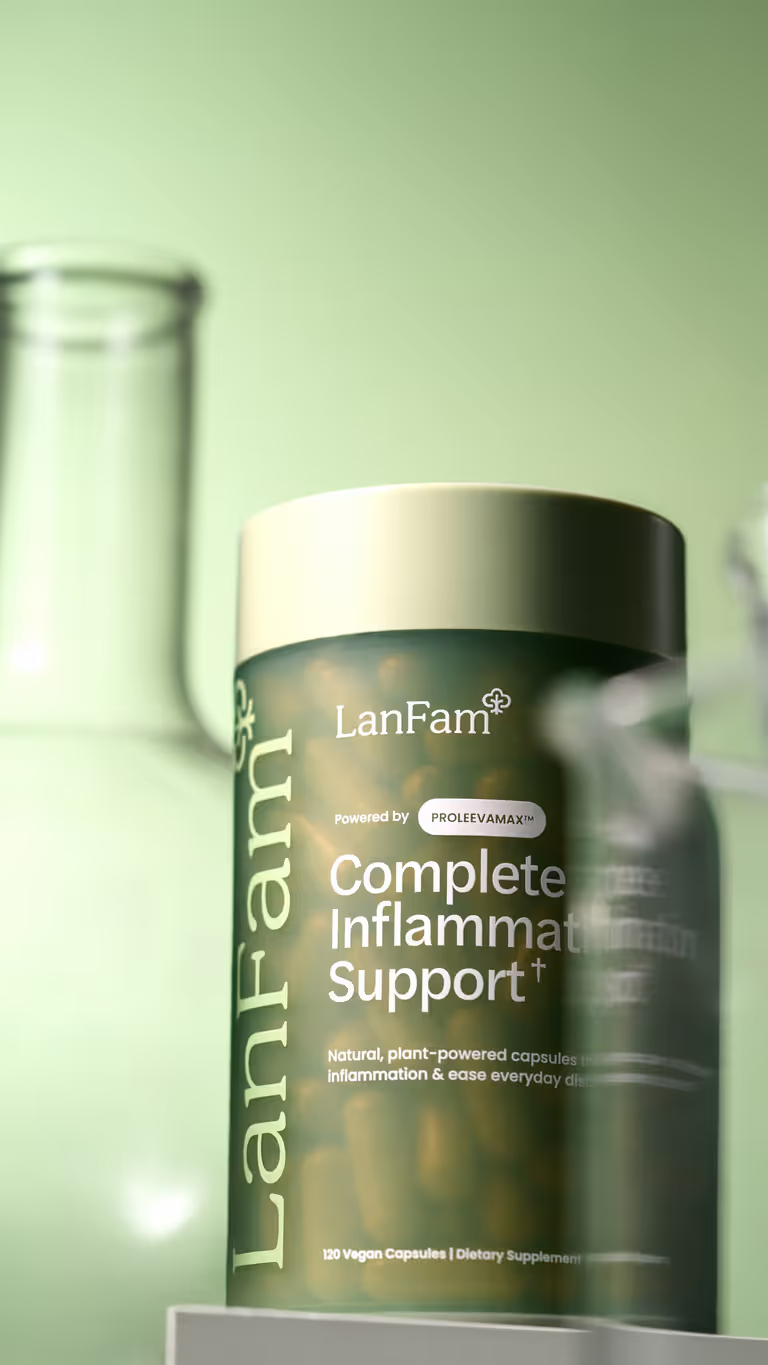
This is exactly why we built ProleevaMax the way we did: standardized curcumin paired with piperine to support absorption, so more of what you take can actually be put to work.* It's one of 13 standardized ingredients in the formula — curcumin isn't the only answer for inflammation, and I'd never pretend it is, but it's a well-evidenced cornerstone.
If we wouldn't give it to our own, we wouldn't make it. Maria takes it every day.
So, can you?
Back to Diane's question. For most healthy adults — yes, taking turmeric and an occasional ibuprofen together is generally considered low-risk. Take the ibuprofen with food, mind your stomach, and you've handled the everyday case.
Pause and ask a professional first if you're on blood thinners, have a bleeding disorder, are heading into surgery, or are taking ibuprofen daily. And if your real goal is to need the ibuprofen less — that's a goal worth having, and curcumin done right (with piperine, consistently, over weeks) is a sensible, evidence-grounded way to chip away at it.

References
- 2.Gupta SC, Patchva S, Aggarwal BB — Therapeutic Roles of Curcumin: Lessons Learned from Clinical Trials. AAPS Journal. 2013. https://doi.org/10.1208/s12248-012-9432-8
- 3.Daily JW, Yang M, Park S — Efficacy of Turmeric Extracts and Curcumin for Alleviating the Symptoms of Joint Arthritis: A Systematic Review and Meta-Analysis of Randomized Clinical Trials. Journal of Medicinal Food. 2016. https://doi.org/10.1089/jmf.2016.3705
- 4.Feng J, Li Z, Tian L, et al. — Efficacy and Safety of Curcuminoids for Knee Osteoarthritis: A Meta-Analysis of Randomized Controlled Trials. BMC Complementary Medicine and Therapies. 2022. https://doi.org/10.1186/s12906-022-03740-9
- 5.Shoba G, Joy D, Joseph T, et al. — Influence of Piperine on the Pharmacokinetics of Curcumin in Animals and Human Volunteers. Planta Medica. 1998. https://doi.org/10.1055/s-2006-957450
Frequently asked questions

There's a seat at our table
Letters from our family to yours — the science, the recipes, the things that actually helped real families. Leave your email and we'll send the next one.