Perimenopause Weight Gain and Inflammation: The Visceral Fat Mechanism Nobody Explains
Maria Lanzieri on perimenopause belly weight as a signaling problem, not a willpower one: how falling estrogen drives visceral fat and NF-kappaB inflammation, and what genuinely helps.
Ingredients in this letter
Someone asked me about this at a wedding last month. We were standing by the dessert table — neither of us touching it — and she leaned in and said, almost embarrassed, "Maria, I haven't changed a thing. Same food, same walks. And it's all going right here." She put her hand flat on her stomach. I knew exactly what she meant before she finished the sentence, because I lived the same confusing year.
So here is the thing I wish someone had said to me plainly, and it's the reason I'm writing this down for you.
Why estrogen leaving changes where weight lands
Estrogen does a lot of quiet jobs, and one of them is keeping a lid on inflammation. It has a genuinely immunomodulatory role — it helps the immune system stay measured rather than reactive.[1] For most of our adult lives, that steadying hand is just there in the background.
During the menopause transition, it withdraws. And researchers who have followed thousands of women through this exact window — the Study of Women's Health Across the Nation, known as SWAN — documented that midlife isn't only about hot flashes and cycle changes. It's also a turning point for cardiometabolic health, with measurable changes in the body's metabolic and cardiovascular markers.[2] A separate large analysis went further and found that the menopause transition itself carries a distinct metabolic signature, independent of simply getting older — including a rise in one inflammatory biomarker, glycoprotein acetyls.[3] And in the research that has looked specifically at the immune side, peri-menopause is described as a pro-inflammatory phase: as estrogen's steadying influence fades, low-grade inflammation tends to come up.[6]
Here's the part nobody explained to me: as estrogen falls, fat doesn't just increase — it moves. Body composition changes across the menopause transition, with fat redistributing toward the abdomen.[4] And the regulation of where and how fat tissue behaves is itself tied to estrogen. When estrogen's influence on fat tissue fades, that tissue becomes more inflammatory and less metabolically friendly.[5]
So the "same food, same walks, all going right here" experience my friend described isn't in her head. It's the predictable result of a hormone stepping back from a job it had been doing for thirty years.
What visceral fat actually is — and why it's loud
Not all fat is the same, and this is the distinction that changed how I think about my own body.
The soft fat just under your skin — the kind you can pinch — is relatively quiet. Visceral fat is different. It sits deeper, packed around the organs in your abdomen, and it behaves almost like an organ itself. It doesn't just store energy. It secretes signaling molecules. And after menopause, the visceral compartment tends to grow.[4]
The molecules it sends out lean inflammatory — messengers like TNF-alpha and IL-6, the same ones your immune system uses to sound an alarm. When visceral fat releases them steadily, it keeps NF-kappaB — that master "alarm" switch inside your cells — activated. And activated NF-kappaB tells the body to stay in a low-grade inflammatory state.†
Now here's the loop, and it's the cruel part: inflammation makes fat tissue behave worse, and worse-behaving fat tissue produces more inflammation. The two reinforce each other. This is why the usual advice — eat a little less, move a little more — so often stalls in this season. You're not just managing calories. You're trying to interrupt a self-feeding signaling cycle.
This is also where it connects to everything else women describe in these years. The same inflammatory shift that's documented at midlife is tied to joint aches, brain fog, and the general "my body feels older than it should" feeling. Estrogen's pullback has even been described in the research as a systemic inflammatory phase — one with consequences well beyond the waistline.[6] If you want the broader picture of how this shows up across the body, I wrote more about the inflammation side of midlife in our piece on supplements for menopause belly fat and the bloating-and-inflammation link most articles miss.
What actually helps — and what doesn't
I'm going to be honest with you the way Fabio is honest with me, because the internet is full of promises and I'm not interested in adding to the pile.
What genuinely helps:
- Strength training, specifically. Muscle is metabolically active in a good way, and it's the lever that holds up best in this season. This matters more than another round of cardio.
- Protein and fiber at every meal. Not a diet — a structure. It steadies blood sugar, which steadies the inflammatory load.
- Sleep. Poor sleep raises inflammatory markers on its own, and it's one of the most underrated pieces of the whole picture.
- Supporting a healthy inflammatory response directly. This is where targeted nutrition comes in — and where the mechanism, not the marketing, should guide you.
What doesn't help — and may make it harder:
- Cutting calories harder. Aggressive restriction tends to cost you muscle, which is exactly the tissue you need to protect. It can also raise stress signaling, which doesn't calm inflammation — it adds to it.
- "Detox" teas and waist trainers. There is no mechanism here. Visceral fat is a signaling problem inside your body, not something you sweat out or cinch away.
- Spot-reduction anything. You can't aim fat loss at your stomach. What you can do is support the inflammatory environment that's making your stomach the place fat wants to gather.
The mechanism tells you why the gimmicks fail: none of them touch the inflammatory signaling that's actually driving the redistribution. For the broader playbook on lowering that signaling load through daily habits, our complete guide to reducing inflammation naturally walks through it step by step.
Where curcumin, resveratrol, and boswellia fit
Fabio talks about this at dinner more than any reasonable person should. But there's a reason these three keep coming up when the conversation is specifically about fat tissue and inflammation — they each act on a different point in the chain I described above.
Curcumin — the active in turmeric — has been studied directly in fat tissue, and this is the one that maps most cleanly onto the visceral-fat story. In adipose tissue, curcumin has been shown to suppress NF-kappaB activation and reduce the inflammatory messengers that fat cells release, while supporting adiponectin, fat tissue's own calming signal.[7] In other words, it acts right at the switch I keep pointing to. That's not a weight-loss claim — it's an inflammatory-response claim, and the distinction matters.
Resveratrol — the compound people associate with red grapes — works through a pathway called SIRT1. In studies on human visceral fat cells specifically, resveratrol increased SIRT1 and adiponectin expression,[8] and in a human model of inflamed fat tissue it lowered the output of inflammatory messengers like IL-6 in a dose-dependent way.[9] Human visceral adipocytes are exactly the cells we've been talking about, which is why I find this line of research so striking.
Boswellia serrata — a botanical you may know as frankincense — comes at inflammation from a different enzyme, the 5-LOX pathway, which drives a separate family of inflammatory signals than the curcumin route. Its actives, the boswellic acids, have been characterized for their role in chronic inflammatory conditions.[10] Pairing it with curcumin is part of why Fabio built our formula the way he did — two different doors into the same overheated room.
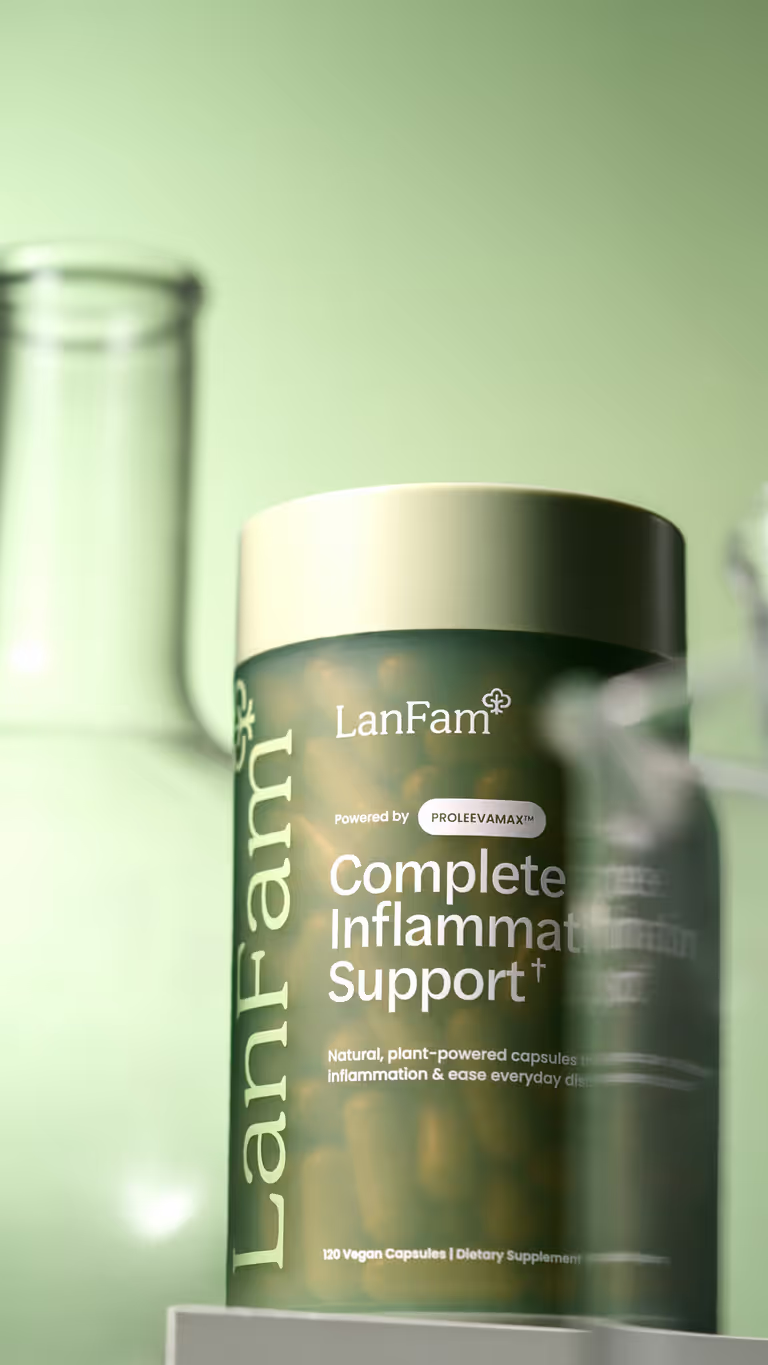
Our formula, ProleevaMax — Complete Inflammation Support — includes all three, standardized and on the label with no proprietary blends, alongside ten other actives. I'm not going to tell you a capsule rearranges your hormones. It doesn't, and anyone who says otherwise is selling you something. What I will tell you is that it's the formula Fabio made for me when my own body went through this, built to support a healthy inflammatory response day after day.* If we wouldn't give it to our own, we wouldn't make it.
A few questions I get asked
Is perimenopause belly fat really caused by inflammation, or by hormones? Both — and they're connected. Falling estrogen redistributes fat toward the abdomen, and the visceral fat that gathers there is itself inflammatory, keeping NF-kappaB activated and feeding a loop.†[4][5][6] It's not one cause; it's a chain.
Can I lose the belly fat by eating less? Eating well helps, but aggressive calorie cutting often backfires by costing you muscle and raising stress signaling. Supporting muscle (strength training, protein) and a calmer inflammatory response tends to do more than restriction alone in this season.
Do supplements for perimenopause weight gain actually work? No supplement changes your hormones or melts fat — please be skeptical of anything that claims it does. What ingredients like curcumin, resveratrol, and boswellia are studied for is supporting a healthy inflammatory response,[7][8][9][10] which is the environment driving where fat lands. That's a real but specific role — support, not a cure.
Why does my weight feel "stuck" even when I'm doing everything right? Because you may be working on calories while the actual driver is signaling. The inflammation-visceral fat loop is self-reinforcing, so the most useful moves are the ones that interrupt the loop: muscle, sleep, blood-sugar steadiness, and supporting the inflammatory response.
Is this the same inflammation behind my joint aches and brain fog? Largely, yes. The midlife inflammatory shift estrogen loss sets off is systemic,[6] which is why so many of these symptoms cluster in the same few years. If joints are your main concern, we go deeper in the research on supplements for menopause joint pain.
I'll end where I started, by the dessert table. What I told my friend that night is what I'll tell you: this isn't a referendum on your discipline. Your body changed the rules, and now you get to learn the new ones. The mechanism is knowable. That, to me, is the hopeful part.
— Maria
*These statements have not been evaluated by the Food and Drug Administration. This product is not intended to diagnose, treat, cure, or prevent any disease. †Refers to the body's inflammatory signaling pathways and to results from an 8-week human evaluation of the formula; individual results may vary.

References
- 2.Taneja V. Sex Hormones Determine Immune Response. Front Immunol. 2018. https://doi.org/10.3389/fimmu.2018.01931
- 3.El Khoudary SR, Greendale G, Crawford SL, et al. The menopause transition and women's health at midlife: a progress report from the Study of Women's Health Across the Nation (SWAN). Menopause. 2019. https://doi.org/10.1097/gme.0000000000001424
- 4.Wang Q, Ferreira DLS, Nelson SM, et al. Metabolic characterization of menopause: cross-sectional and longitudinal evidence. BMC Med. 2018. https://doi.org/10.1186/s12916-018-1008-8
- 5.Marlatt KL, Pitynski-Miller DR, Gavin KM, et al. Body composition and cardiometabolic health across the menopause transition. Obesity (Silver Spring). 2022. https://doi.org/10.1002/oby.23289
- 6.Steiner BM, Berry DC. The Regulation of Adipose Tissue Health by Estrogens. Front Endocrinol. 2022. https://doi.org/10.3389/fendo.2022.889923
- 7.McCarthy M, Raval AP. The peri-menopause in a woman's life: a systemic inflammatory phase that enables later neurodegenerative disease. J Neuroinflammation. 2020. https://doi.org/10.1186/s12974-020-01998-9
- 8.Shehzad A, Ha T, Subhan F, Lee YS. New mechanisms and the anti-inflammatory role of curcumin in obesity and obesity-related metabolic diseases. Eur J Nutr. 2011. https://doi.org/10.1007/s00394-011-0188-1
- 9.Costa Cdos S, Rohden F, Hammes TO, et al. Resveratrol upregulated SIRT1, FOXO1, and adiponectin and downregulated PPARgamma1-3 mRNA expression in human visceral adipocytes. Obes Surg. 2011. https://doi.org/10.1007/s11695-010-0251-7
- 10.Zagotta I, Dimova EY, Debatin KM, et al. Obesity and inflammation: reduced cytokine expression due to resveratrol in a human in vitro model of inflamed adipose tissue. Front Pharmacol. 2015. https://doi.org/10.3389/fphar.2015.00079
- 11.Ammon HPT. Modulation of the immune system by Boswellia serrata extracts and boswellic acids. Phytomedicine. 2010. https://doi.org/10.1016/j.phymed.2010.03.003
There's a seat at our table
Letters from our family to yours — the science, the recipes, the things that actually helped real families. Leave your email and we'll send the next one.