Supplements for Menopause Belly Fat: What Targets the Visceral Inflammation Loop
The best supplements for menopause belly fat target the inflammation-insulin-visceral-fat loop — not appetite. Doses, mechanisms, and honest limits.

A woman named Diane wrote to us last spring. Sixty-one, retired schoolteacher, walked four miles most mornings of her life. She told me she hadn't changed a single thing about how she ate or moved — and over about three years, her waistbands had quietly stopped fitting. "I'm doing everything I used to do," she said, "and my body is acting like a stranger." Then the line that stuck with me: "What supplement do I take for this?"
I want to answer that question honestly, the way I'd answer it for Maria — because I get a version of Diane's letter almost every week. And the honest answer has two halves. The first half is the hard one: there is no capsule that melts belly fat, and anyone selling you one is selling you a story. The second half is the useful one: menopause belly fat isn't a willpower problem, it's an inflammation problem with a hormonal trigger — and a handful of supplements do real, measurable work on the inflammation side of that problem. The trick is knowing which ones, at what dose, and where they stop.
So let me sit down and walk through it properly.
Diane's Real Question: Why the Old Rules Stopped Working
Diane didn't get lazy. Her biology changed the terms of the deal — and most weight-loss advice is written for a body she no longer has.
"Eat less, move more" assumes the fat you're carrying behaves like the fat you carried at thirty-five. It doesn't. The fat that shows up at the midline during the menopause transition is a different kind of fat, in a different place, doing a different job. Once you understand that, the whole supplement question reorganizes itself — you stop asking "what burns fat" and start asking "what quiets the signal that keeps making it."
I wrote the deep mechanism story in a separate letter — if you want the full "why," read my deeper letter on perimenopause weight gain and inflammation. Here I'll give you enough of the biology to make the supplement choices make sense, then get practical.
The Biology: Why Menopause Belly Fat Is Different
There's a loop. Let me draw it for you piece by piece, because every supplement on this page either does or doesn't touch a node of it.
1. Falling estrogen moves fat from your hips to your belly. Before menopause, women store fat in a gynoid pattern — hips, thighs, the places estrogen prefers. As estrogen falls, storage shifts to an android pattern: the abdomen, and specifically the visceral depot wrapped around your organs. This redistribution happens even in women whose total weight on the scale barely moves. The body-composition work across the menopause transition documents it as one of the most consistent findings in the field [1], and the regulation of where fat goes traces directly back to estrogen's grip on adipose tissue [2]. This is the hormonal trigger. Diane's scale lied to her because the fat moved before it multiplied.
2. Visceral fat is not quiet fat — it's a gland. Subcutaneous fat (the soft stuff on your thigh) mostly just sits there. Visceral fat is metabolically active: it actively secretes inflammatory cytokines — TNF-α, IL-6, resistin — into your circulation. The metabolic profiling of menopause shows this inflammatory and lipid shift moving in lockstep with the hormonal change [3]. So the moment fat relocates to the belly, it starts broadcasting inflammation to the rest of the body.
3. That inflammation drives insulin resistance. The cytokines coming off visceral fat interfere with how cells respond to insulin. Insulin resistance means more glucose and more insulin circulating — and insulin is a fat-storage signal. Estrogen normally helps keep this in check, which is part of why its decline is genuinely a "systemic inflammatory phase," not just a reproductive one [4]. And because falling estrogen also tilts the immune system toward a more inflammatory baseline [5], the body has less of its old buffering capacity right when it needs more.
4. The loop closes — and feeds itself. More insulin resistance → more visceral storage → more cytokines → more insulin resistance. Round and round:
visceral fat → inflammation → insulin resistance → more visceral fat → more inflammation.
5. Sleep, stress, and muscle loss pour fuel on it. Hot-flash-disrupted sleep worsens insulin sensitivity overnight. Cortisol from chronic stress deposits fat preferentially in the visceral depot. And age-related muscle loss lowers your resting metabolism and your capacity to pull glucose out of the blood. None of these are the trigger, but each one spins the loop faster.
Here's the translation, the part I want Diane — and you — to hold onto: menopause belly fat is an inflammation-insulin problem with a hormonal trigger, not a calorie problem with a willpower failure. That single reframe is why the supplements worth your money target the inflammation-insulin loop, and why "fat burners" and appetite tricks miss the point entirely.
Before Any Supplement: The Foundation That Actually Moves the Needle
I have to put this before the list, not after it, because if you skip it the rest is wasted money. The supplements on this page are adjuncts. They amplify a protocol. They do not replace one. Three things do more for menopausal body composition than any capsule I could hand you:
- Resistance training, 2–3x a week. This is the single most effective non-supplement intervention, full stop. It preserves the muscle that holds your metabolic rate up, and it improves insulin sensitivity directly — the exact node the loop is stuck on. No supplement replicates it.
- Protein — most menopausal women need ~100g a day. Protein protects muscle against the age-related loss that's quietly dragging your metabolism down, and it's the most satiating macronutrient.
- Seven-plus hours of actual sleep, and a Mediterranean-pattern diet. Real sleep, not "time in bed." Disrupted sleep elevates cortisol and worsens insulin resistance independent of what you eat. And the dietary pattern that consistently supports a healthy inflammatory response is the Mediterranean one — start with our anti-inflammatory breakfast if you want a concrete first move.*
If those four aren't in place, fix them first. Supplements layered on top of that foundation are an accelerant. Layered on top of nothing, they're an expensive placebo.
What Doesn't Work (Don't Waste the Money)
The honest clearing of the shelf, before the part where I tell you what's worth keeping. Most of the "menopause belly weight loss supplements" marketed to you live here:
- Chromium picolinate. Extensively studied for weight and insulin resistance; the high-quality reviews land on no meaningful effect for otherwise healthy adults.
- Raspberry ketones. A marketing story built on a single petri-dish study. No credible human evidence.
- Garcinia cambogia (HCA). Trialed thoroughly, effect near zero — and associated with rare but real liver injury.
- Green coffee bean extract. A small effect in short, weak trials that evaporates when the studies get rigorous.
- CLA (conjugated linoleic acid). Modest, inconsistent results — and some signals that it may worsen insulin sensitivity, which is the opposite of what this loop needs.
- "Belly-fat burners" as a category. "Targeted fat loss" is an excellent marketing frame and a physiological impossibility. You cannot spot-reduce with a capsule.
Skip all of it. Move the money to the short list that follows.
The 8 Supplements That Target the Biology
I've kept the same eight I'd recommend to Maria, and I've graded each one honestly — A where the human evidence is genuinely strong, B where it's reasonable but thinner, and a plain note where it's still emerging. Read the grade as carefully as the dose.
1. Multi-Ingredient Anti-Inflammatory Formula
Evidence grade: B (formula-dependent) | Typical approach: standardized botanicals + amino acids in one daily dose
The highest-leverage category for menopause belly fat is a multi-ingredient formula aimed at the inflammation node — because that node is upstream of the rest of the loop. Quiet the chronic cytokine signaling coming off visceral fat and you take pressure off the insulin-resistance step that keeps the whole thing storing fat. This is the most leverageable place to push.
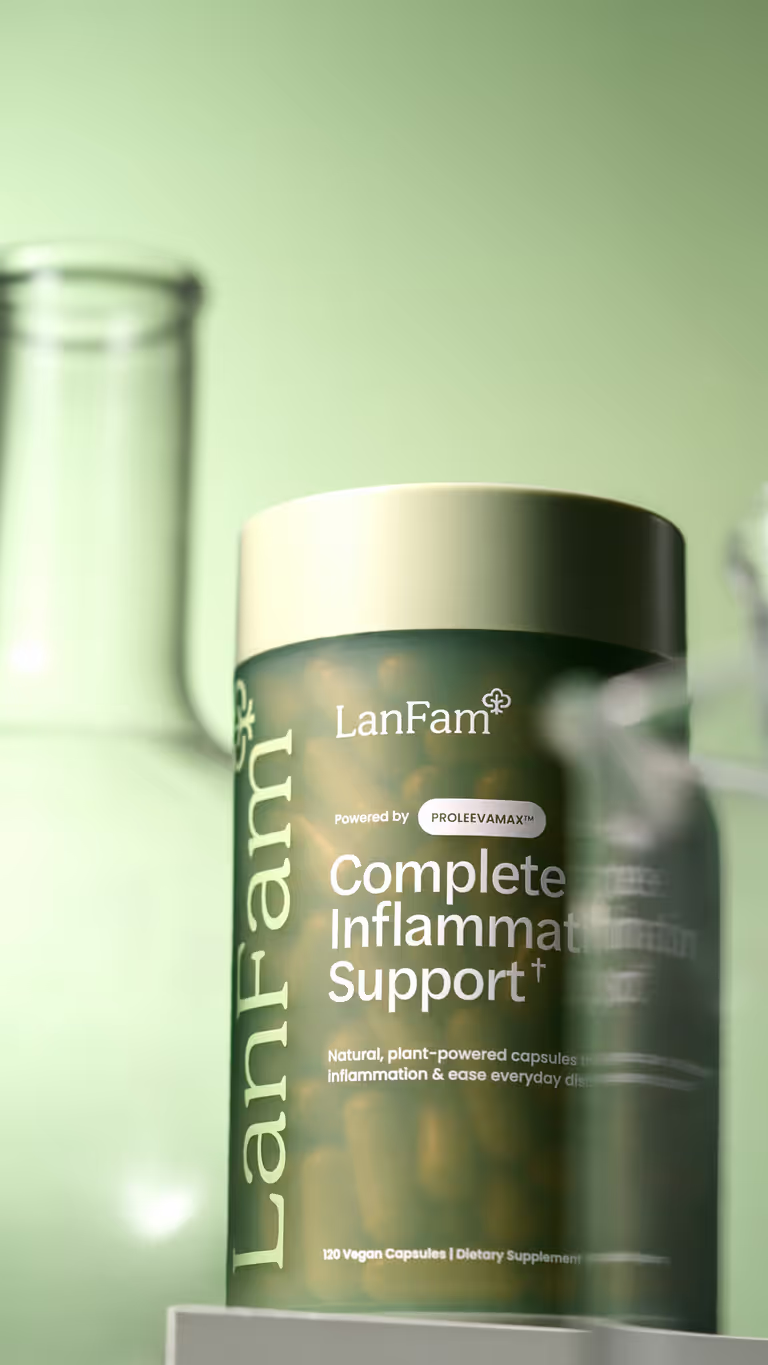
That's the entire rationale behind ProleevaMax: 13 standardized ingredients, built at our kitchen table for Maria, that work on inflammation rather than chasing "fat burning." The two actives I'd point a belly-fat reader to are the botanicals with the most mechanistic relevance here. Curcumin (turmeric root extract, paired with black pepper for absorption — piperine measurably raises curcumin's bioavailability [6]) has a dedicated literature on its anti-inflammatory role in obesity specifically: it acts on the NF-κB inflammatory pathway inside fat tissue and is one of the better-characterized natural compounds at the inflammation-metabolism intersection [7], with a broad clinical review backing its safety and signal across inflammatory conditions [8]. Boswellia serrata (standardized to 65% boswellic acids) works on a different inflammatory enzyme (5-LOX) and the same cytokines visceral fat throws off — more on that in slot 7. The formula also carries Matcha green tea (EGCG — slot 8) and amino acids like L-Glutamine that support the gut barrier (slot 6's mechanism).
A formula organized around inflammation is doing mechanistic work on the problem. A single-ingredient "fat burner" is not. That's the honest distinction — and it's why I present ProleevaMax as the anchor of a stack, never the only answer.*
2. Omega-3 Fatty Acids (EPA + DHA)
Evidence grade: A | Typical clinical dose: 2,000–3,000 mg combined EPA + DHA daily
If I could give Diane only one bottle, it'd be this one. Omega-3s touch more than one node of the loop, and the human evidence is the strongest on the page:
- They shift inflammatory tone toward resolution. EPA and DHA are the raw material your body turns into resolvins — the molecules that actively switch off inflammation rather than just blocking it. In the joint-pain literature, EPA/DHA produced a measurable analgesic effect across pooled trials, which tells you the anti-inflammatory action is real and dose-dependent [9].*
- They support insulin sensitivity — the insulin-resistance node specifically.
- They've been linked to less visceral fat in several small trials, though the effect sizes are modest and I won't oversell them.
Choose fish oil or algal oil. Skip flax-based ALA — it converts to EPA/DHA so poorly it's almost a different supplement.
3. Berberine
Evidence grade: A (for insulin sensitivity) | Typical clinical dose: 500 mg, 2–3x daily, with meals
Berberine is a plant alkaloid (from goldenseal, barberry) that has become one of the most-studied natural compounds for metabolic health. Its evidence for insulin sensitivity and blood-sugar regulation is genuinely strong — the human trials are largely in people with type 2 diabetes or metabolic syndrome, where it consistently improves fasting glucose and insulin response through AMPK activation, the same cellular switch exercise pulls.
I'm grading the insulin-sensitivity claim an A and being deliberately careful about the rest: the body-composition evidence is thinner than the metabolic evidence, and most trials sit in diabetic populations rather than healthy menopausal women. But improving the insulin-resistance node is a biologically sound target for this loop. The honest caveats matter here more than anywhere:
- GI side effects are common the first 1–2 weeks (gas, loose stool). Start at 500 mg once daily and build up.
- Berberine interacts with real medications — metformin, blood-pressure drugs, blood thinners. Do not start it without talking to your prescriber if you take any of those.
- It works on a 6–12 week clock, not overnight.
Not in ProleevaMax. This is a targeted add-on for the woman who's identified insulin resistance specifically as part of her picture.
4. Vitamin D3
Evidence grade: B | Typical clinical dose: 1,000–4,000 IU daily, based on blood level
Low vitamin D travels with visceral adiposity, insulin resistance, and higher inflammatory markers in postmenopausal women. Whether supplementing reverses that, or whether low D is just a marker of broader metabolic trouble, is still genuinely debated — so I won't overstate it. But deficiency is extraordinarily common after menopause (well above half of women), correction is cheap and safe, and the downside is essentially nil.
Test your 25(OH)D before you supplement. Aim for 40–60 ng/mL, dose to get there, and don't chase numbers beyond it.
5. Magnesium (Glycinate or Citrate)
Evidence grade: B | Typical clinical dose: 200–400 mg elemental magnesium, evening
Magnesium quietly supports three of the loop's amplifiers at once — insulin sensitivity, cortisol regulation, and sleep quality. Low magnesium status tracks with insulin resistance and visceral fat, and deficiency is common after menopause. It's not a fat-loss agent; it's a foundational supplement that takes pressure off the sleep-and-cortisol side of the loop for very little money.
Magnesium glycinate is the gentlest, best-absorbed form for evening use. Magnesium oxide is poorly absorbed — skip it.
6. Probiotics (Strain-Specific)
Evidence grade: emerging (modest human data) | Typical clinical dose: 10–50 billion CFU, multi-strain, daily
Here I'm going to be straight with you, because the brand's whole point is honest grading: the probiotic-and-visceral-fat story is biologically plausible and clinically thin. Your gut microbiome influences how efficiently you extract calories, how inflammation is modulated, and how estrogen is recycled (the "estrobolome"). Specific strains — certain Lactobacillus gasseri lines in particular — have shown modest visceral-fat reductions in smaller trials, but replication across populations has been mixed. I'm not citing a single trial as proof, because the honest summary is "smaller trials, mixed replication, plausible mechanism."
Treat probiotics as support for the microbiome-inflammation piece — and if gut symptoms are part of your picture at all, the deeper read is how your gut barrier drives whole-body inflammation. Don't treat probiotics as a standalone belly-fat intervention.
7. Boswellia Serrata (Standardized to Boswellic Acids)
Evidence grade: B (for inflammatory signaling) | Typical clinical dose: 100–250 mg standardized extract (minimum 30% boswellic acids), twice daily
Boswellia's direct effect on visceral fat hasn't been studied much — and I won't pretend otherwise. What is well-characterized is its effect on the inflammatory machinery: boswellic acids modulate the immune response and the very cytokines (IL-6, TNF-α) that visceral fat pumps out [10]. Quiet those, and you take pressure off the insulin-sensitivity side of the loop. The same body of work that makes boswellia a credible joint-comfort ingredient is what makes it relevant here — if you want that fuller case, see the benefits of boswellia serrata.
Boswellia at 65% boswellic acids is in ProleevaMax for exactly this reason — and it's why you want a formula that states its standardization percentage, not one that lists "frankincense extract" and hopes you don't ask.*
8. Green Tea Extract / EGCG
Evidence grade: B | Typical clinical dose: 300–500 mg EGCG daily
Epigallocatechin gallate — the lead catechin in green tea — has the most direct "metabolism" story of the bunch: it's been studied for fat oxidation, thermogenesis, and inflammatory markers, with modest but measurable waist-circumference and weight reductions over 12-plus weeks, especially alongside caffeine. It also dampens NF-κB signaling, which is why it sits naturally next to curcumin and boswellia on the inflammation side.
Worth noting: Matcha green tea is one of ProleevaMax's 13 ingredients, so part of this mechanism is already in the formula. Higher-dose standalone EGCG is an optional fine-tune for the woman targeting belly fat specifically who tolerates caffeine and wants more than a multi-ingredient dose delivers.
How to Sequence These (a Practical 90-Day Plan)
Most women don't need all eight at once. Diane didn't. Here's the order I actually recommend — foundation first, targeted second, fine-tuning last.
Foundation (Weeks 1–4):
- Multi-ingredient anti-inflammatory formula — the inflammation node, highest leverage
- Vitamin D3, dosed to your blood level
- Magnesium glycinate at bedtime
- Omega-3 EPA/DHA, 2,000–3,000 mg daily
Targeted add-on (Weeks 4–8), if the needle isn't moving:
- Berberine — if fasting glucose or HbA1c is elevated, or insulin resistance is documented; provider-supervised if you're on other medications
- A multi-strain probiotic
Optional fine-tuning (Weeks 8–12):
- Additional EGCG on top of the formula, if you tolerate caffeine
- Adjust based on what actually responded
Ninety days is the floor for inflammatory markers, insulin sensitivity, and body composition to shift. A two-week supplement experiment doesn't produce data — it produces a quit.
What These Supplements Cannot Do (the Honest Limits)
Three plain truths I'd want a friend to hear before she spends a dollar:
- No supplement replaces resistance training. Two to three strength sessions a week is the most effective lever you have for menopausal body composition. No capsule replicates muscle.
- No supplement overrides the diet. Supplements support your biology; they don't out-argue a dietary pattern that keeps storing visceral fat. They slow the trajectory — they don't reverse one you're actively feeding.
- No supplement replaces sleep. Disrupted sleep drives visceral fat independent of diet, through cortisol and insulin. Seven-plus real hours is foundational, not optional.
The supplements on this list amplify a protocol. They don't become one. That's not a disclaimer — it's the whole truth of the thing, and it's the part the "belly-fat burner" aisle will never tell you.
Where ProleevaMax Fits
I built ProleevaMax to be the anchor of that foundation stack — 13 standardized ingredients aimed squarely at the inflammation node of the visceral-fat loop, with curcumin and boswellia at clinically-relevant standardizations and every dose printed on the label. No proprietary blends. It comes with a 90-day money-back guarantee for one simple reason: 90 days is what this biology actually requires, so that's how long you should get to judge it.*
If your trouble is bloating rather than the deeper midline change, that's a different problem with a different answer — read supplements for menopause bloating. And if you want to understand the broader inflammatory picture that menopause sets off across your whole body, the menopause inflammation symptoms map lays it out.
I wrote back to Diane with most of what's on this page. She didn't need a miracle. She needed to know her body wasn't betraying her — it was running a loop — and that she could put her hands on the inflammation end of it. That's the gap we built the formula to close: not the emergency, the day-to-day rebuild.

References
- 2.Marlatt KL, Pitynski-Miller DR, Gavin KM, et al. — Body composition and cardiometabolic health across the menopause transition. Obesity. 2022. https://doi.org/10.1002/oby.23289
- 3.Steiner BM, Berry DC. — The Regulation of Adipose Tissue Health by Estrogens. Front Endocrinol. 2022. https://doi.org/10.3389/fendo.2022.889923
- 4.Wang Q, Ferreira DLS, Nelson SM, et al. — Metabolic characterization of menopause. BMC Med. 2018. https://doi.org/10.1186/s12916-018-1008-8
- 5.McCarthy M, Raval AP. — The peri-menopause: a systemic inflammatory phase. J Neuroinflammation. 2020. https://doi.org/10.1186/s12974-020-01998-9
- 6.Taneja V. — Sex Hormones Determine Immune Response. Front Immunol. 2018. https://doi.org/10.3389/fimmu.2018.01931
- 7.Shoba G, Joy D, Joseph T, et al. — Influence of piperine on the pharmacokinetics of curcumin. Planta Med. 1998. https://doi.org/10.1055/s-2006-957450
- 8.Shehzad A, Ha T, Subhan F, Lee YS. — New mechanisms and the anti-inflammatory role of curcumin in obesity. Eur J Nutr. 2011. https://doi.org/10.1007/s00394-011-0188-1
- 9.Gupta SC, Patchva S, Aggarwal BB. — Therapeutic roles of curcumin: lessons learned from clinical trials. AAPS J. 2013. https://doi.org/10.1208/s12248-012-9432-8
- 10.Goldberg RJ, Katz J. — A meta-analysis of the analgesic effects of omega-3 polyunsaturated fatty acid supplementation for inflammatory joint pain. Pain. 2007. https://doi.org/10.1016/j.pain.2007.01.020
- 11.Ammon HPT. — Modulation of the immune system by Boswellia serrata extracts and boswellic acids. Phytomedicine. 2010. https://doi.org/10.1016/j.phymed.2010.03.003
Frequently asked questions
There's a seat at our table
Letters from our family to yours — the science, the recipes, the things that actually helped real families. Leave your email and we'll send the next one.